
sympathy
in which the author considers systems of magic and who benefits from them

It’s hard to think of a fantasy book that doesn’t contain some sort of magic. Whether it’s wizards using true names to master the world around them, children born with the power to still (or cause) earthquakes, or competing schools of necromancy, one of the hallmarks of a great work of fantasy is often the vivid and original way it uses magic in its world and narrative.
If you’re keyed in to discussions of fantasy books lately, then you’ve almost certainly heard the terms “hard magic system” and “soft magic system” as ways of categorizing how defined the rules of magic in a given work are, from the reader’s perspective. Hard magic systems have clearly-laid out parameters for how magic in the setting works, and in their purest form are practically scientific - if X, then Y. As long as a character follows the correct steps - says the right words, makes the right hand motions, activates the right components or substances - then the expected magic outcome occurs. Soft magic systems, on the other hand, are less clear-cut. The arcane is more intuitive, more unpredictable, more obscure, and though rules may govern it, those rules aren’t spelled out for the reader.
Hard magic systems in particular have been seeing a lot of interest lately.
Whether it’s innumerable requests for hard magic system recommendations on Reddit, or the surge of interest in subgenres like litRPGs and progression fantasy, a lot of attention and desire is being paid to stories where the magic not only follows clear, definable rules, but those rules provide a ladder to power and success. Mastering magic is as simple as knowing how it works. After all, to paraphrase Arthur C. Clarke, “magic is just science we don’t understand yet.” Magic has laws it obeys just as physics and chemistry do, and once you understand those laws, its power is under your control.
knowledge is power
I recently had a discussion with a friend about the use of magic in a TV show, where she said she preferred the tone shifting so that the magic became explainable and treated like science, whereas to me the entire appeal of magic in a story is that it isn’t logical and operates according to the emotional and narrative needs of the characters. (To no one’s surprise, she used to teach high school physics.) To control something you have to understand it, and now that we live in the age of Information, perpetually swimming in a sea of facts and data (whether true or false), we expect to understand things more than ever.
You can see the symptoms of this hunger for knowledge - or more accurately, discomfort with ignorance - in a lot of the prequel content that media franchises are putting out. Every character needs a backstory, every villain needs an origin, every nickname and quirk included without a second thought in the original movie now needs an on-screen explanation for how it came to be. We live in a culture of convenience, of rideshares and Instacart and same-day delivery, and the same attitude applies to how many people consume media. They are uncomfortable with gaps in the storytelling. They need answers to every little thing. Rather than allow themselves to think through those empty spaces and fill it with their own imagination or interpretation, they call the storyteller lazy and illogical instead.
And yet at the same time, while the quantity of information we have access to is ever-increasing, its quality is becoming more and more nebulous. AI, disinformation campaigns, false speculation, and outright propaganda and lies clog our feeds at an exponential rate. In an increasingly-more precarious society, having knowledge about the inner workings of magic - of power - fulfills one of the oldest fantasies of all: knowing the unknown. Reading a progression fantasy where every step of the hero’s journey to power is laid out before him, the exact amount of training and fights he must do predetermined, allows the reader to visit a world where they know what needs to be done. There is no mystery, no reliance on intuition or guesswork. Knowledge and hard work are rewarded with success. The appeal of hard magic systems is a power methodology where the better you follow the rules, the more power you accumulate.
The thing is, all stories about magic are really stories about socioeconomic and political power and who could or should wield it. Stories where magic ability is determined by genetics and bloodline have a hard time divorcing themselves from the specter of racism and eugenics; many other narratives focus on the ethics of magic regulation and control; still others give magic to characters who are otherwise powerless in society as a way to balance the scales.
With that lens, the appeal of a hard magic system should be obvious, their rise in popularity fueled by the desire for the functional meritocracy that our generation was promised in childhood but many are now discovering to be a lie. The old logic of “study hard, work hard, provide for yourself and your family,” is crumbling. College degrees cost more than ever for increasingly diminishing returns, wages are stagnating while cost of living skyrockets, and many of the hardest workers in society - nurses and firefighters, day laborers, workers in retail and food services - increasingly struggle to make ends meet while the richest of the rich enjoy leisurely lives and spend more in a single shopping spree than many make in an entire year. It is not only possible but likely to do everything right, to play the system entirely by the rules you are given, and still fail. Hard magic systems offer an antidote to that.
These magic systems hold the most appeal for people who already occupy demographic positions of privilege - in America, that being (usually straight, usually white) men - because they feel the sting of disillusionment the keenest. After all, the socioeconomic systems failing them now are the ones that were always supposed to work in their favor. If anyone feels entitled to a world where following a proscribed path inevitably results in success, it’s them.
The other demographic to whom hard magic systems appeal is a more nebulous one: people who were socially isolated but academically high-performing as adolescents. Because, once again, the fantasy is the better you follow the rules, the more power you earn. Ideally enough to prove wrong everyone who bullied or looked down on you, to make you a respected member of society due purely to your own intelligence and hard work, rather than an outcast.
The Venn diagram of these two groups should not come as a surprise.
Hard magic systems, and cultivation/progression fantasies in particular, are not anything new. They’re just the anime nerd equivalent to Patrick Bateman-esque fantasies of climbing the corporate ladder, of wearing the right clothes, speaking the right words, doing the right actions, until you’re rewarded with power, success, and a seat at the head of the table. The aesthetics are different, but the underlying logic is exactly the same.
power is power
If many white men are grappling with disillusionment, women and cultural minorities less so. We have much less faith that following the rules will bring good results; we’re used to systems being manipulated to work against us instead. One of the most enduring ways this appears in fiction is the classic dichotomy between wizards and witches. Wizards are venerated elders, having acquired their power through long decades of study and work (though not immune to corruption); a witch is always an outcast in one way or another, separate from society, her magic drawn from the wildness of nature, or dark spirits, or something even stranger.
“I don’t know,” Tenar said. “It seems to me we make up most of the differences, and then complain about ‘em. I don’t see why the Art Magic, why power, should be different for a man witch and a woman witch. Unless the power itself is different. Or the art.”
“A man gives out, dearie. A woman takes in.”
Tenar sat silent but unsatisfied.
“Ours is only a little power, seems like, next to theirs,” Moss said. “But it goes down deep. It’s all roots. It’s like an old blackberry thicket. And a wizard’s power’s like a fir tree, maybe, great and tall and grand, but it’ll blow right down in a storm. Nothing kills a blackberry bramble.” She gave her hen-chuckle, pleased with her comparison.
from Tehanu by Ursula K. Le Guin
When I was having the discussion that would become the seeds of this essay with some other creatives, one of them remarked “Soft magic feels queer but I don’t know why.” Hard magic is about making the system work for you. Soft magic is about working against the system. A truly soft magic system in a story defies explanation; it works according to the demands of the plot, of the characters and their emotional arcs, of the metanarrative voice. There is no equation or law that determines how Galadriel in The Lord of the Rings works her elf-queen magic; she only just does.
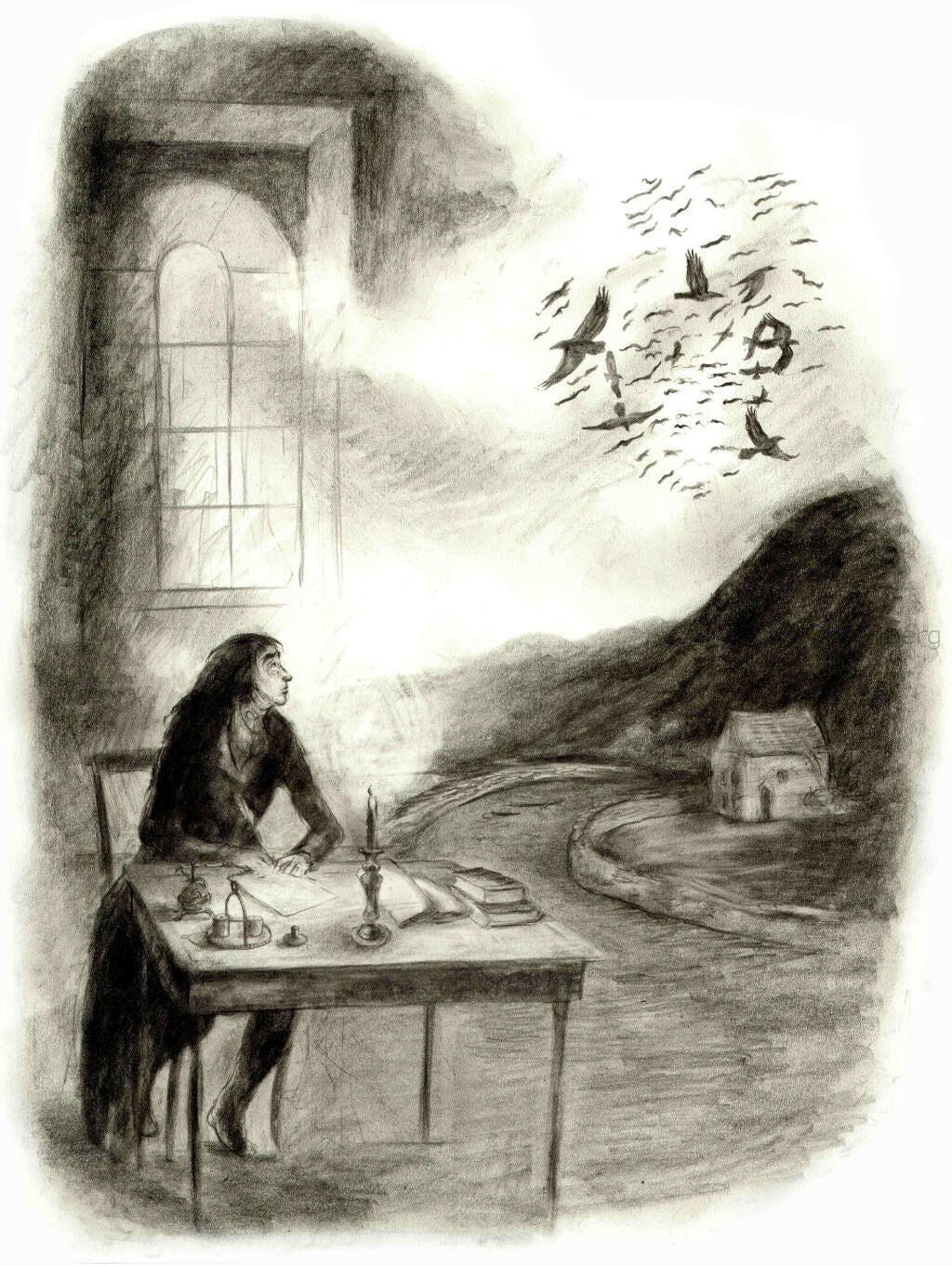
Jonathan Strange and Mr. Norrell is one of my favorite fantasy books of all time for a variety of reasons. One of the things it does so well is examine this interaction between magical power and socioeconomic power. In Regency England where it takes place, the study and practice of magic are only socially acceptable for gentlemen, that is white, land-owning, Christian adult men. Strange and Norrell both belong to this class, and in fact Norrell is incredibly concerned, among other things, with limiting who can study magic to as few people as possible. Strange is more liberal in his thinking, but even so, his main quest is the same as Norrell’s - to take the faerie magic of England that they have been using it and codify it, master it, control it. That is to say - to take a soft magic system and turn it into a hard one. Their main opponent, the gentleman with the thistle-down hair, is a faerie king, a master of intuitive magic, and more than a little queer. And yet at the end, Strange and Norrell fail. They attempt to wrest control over magic and in doing so discover how pitifully little they actually understand. Magic returns to England and anyone, women and children and Jews and the poor, can use it, and a Black man is king of Faerie, and Strange and Norrell know even less about magic than when they began.
Everyone is entitled to their preferences, or so they tell me, and it should be clear at this point what mine is. I have no interest, as either a writer or a reader, in treating magic like a science. To me, that undermines the entire point of what magic is. I find far more interest and imaginative stimulation in something that is weird and wonderful and defies explanation, that gives us not what we want but what we need, that turns social structures on their heads and gives power to those who had none before. After all, as the song goes:
I do not find worthiness in virtue
I no longer try to be good
It didn’t keep me safe
Like you told me that it would
So come on, tear me wide open
A terrible gift
Let the chorus console me
Sympathy magic
Cover image: “The Enchanter Merlin” from The Story of King Arthur and His Knights illustrated by Howard Pyle, pub. 1903.
I suppose the whole Harry Potter universe is hard magic? Very hard, perhaps, since it is all taught in a systematic way, year by year? But it never quite made sense since the same spell in the mouth of a professor had a lot more potency than when uttered by one of the students, no matter how accurately.